Beyond .com: How TLD Choices Impact SEO and Branding in 2026
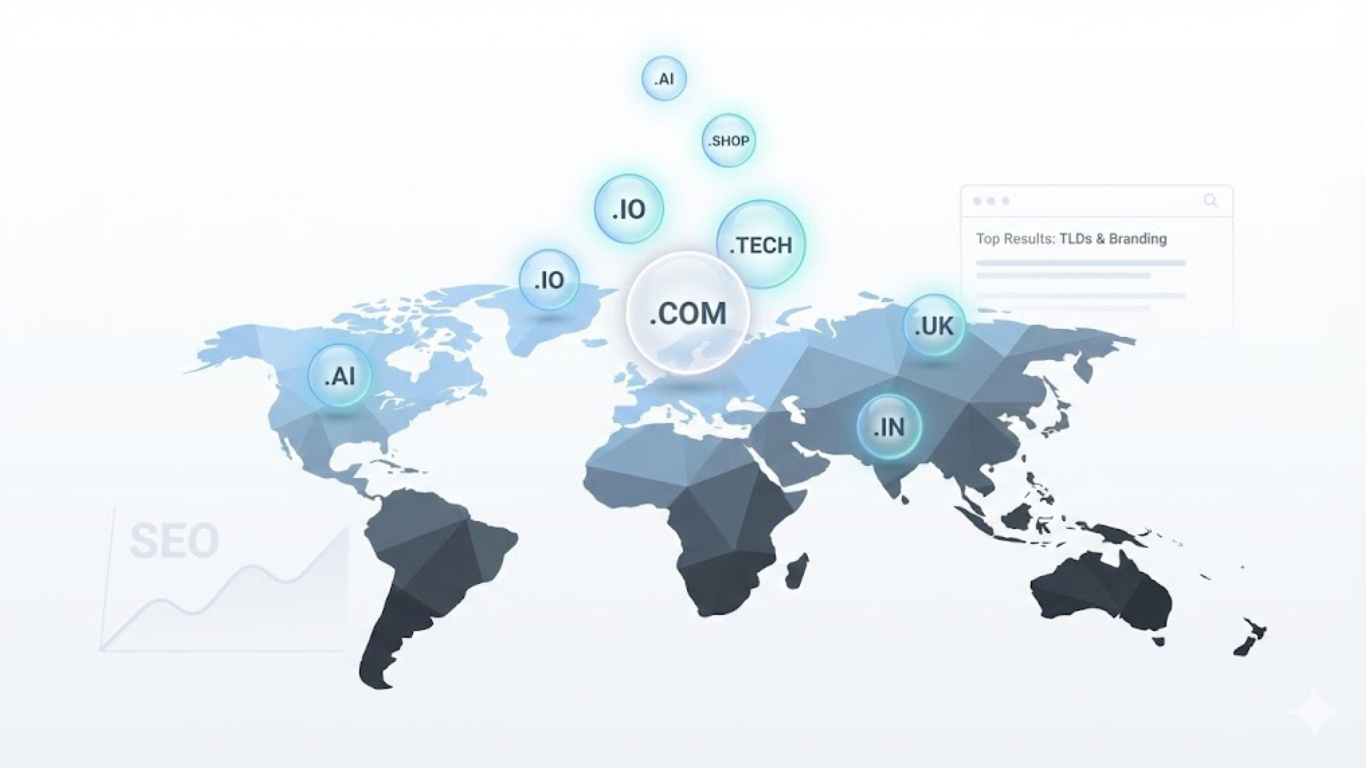
This guide breaks down how different domain extensions (.com, ccTLDs, and new gTLDs) actually influence SEO, trust, and branding in 2026. Use the sections below to quickly jump to the parts most relevant to your business or startup.
Introduction
For decades, .com was the default choice for anyone launching a website. It signalled credibility, offered broad appeal, and felt “right” in a way that other extensions didn’t. But 2026 tells a different story.
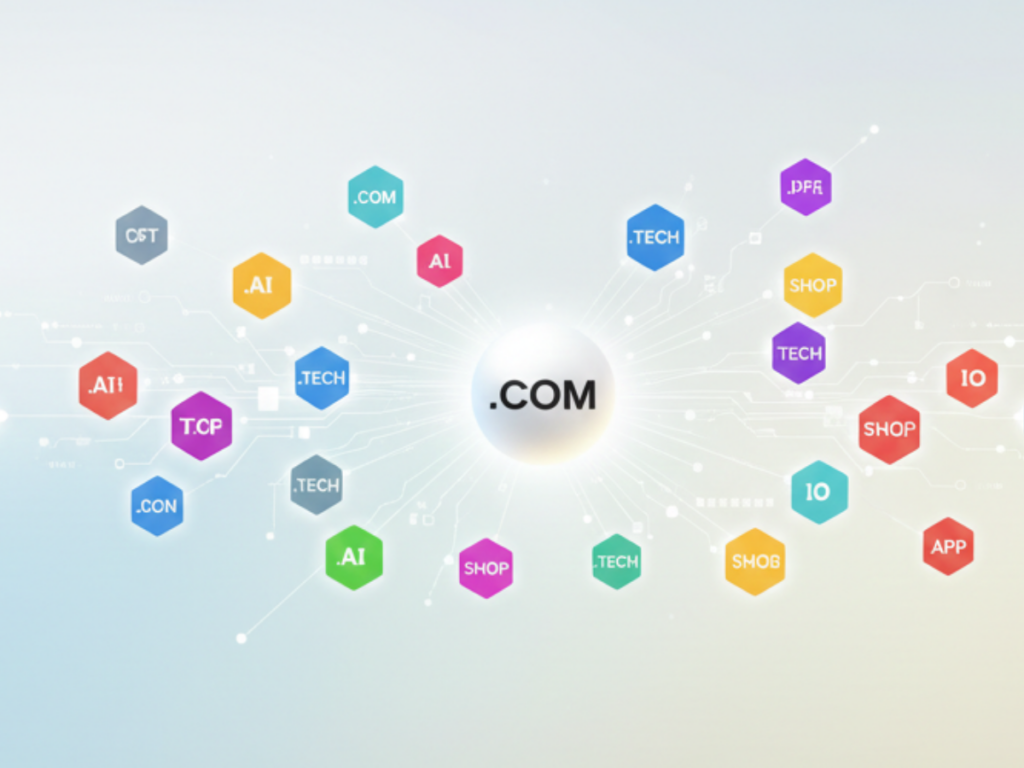
As of early 2025, domain registrations have reached 364.3 million, with new generic top-level domains (ngTLDs) like .ai, .tech, and .shop growing at 13.5% year-over-year. Meanwhile, legacy .com and .net registrations have begun to decline. Today, 54% of tech startups use alternative TLDs as their primary domain, signalling a fundamental shift in how businesses think about online identity.
The question isn’t whether domain extensions and SEO are connected—it’s more nuanced than that. Google treats all gTLDs equally in its ranking algorithms. But the choice of extension still influences user behaviour, brand perception, and local search visibility in ways that matter far more than most realise, especially when you consider how your domain name shapes brand perception.
Does Your Domain Extension Affect SEO Rankings?
Let’s start with the clearest answer: No, domain extensions do not directly impact Google rankings.
Google has consistently stated that all generic top-level domains (gTLDs)—whether .com, .ai, .shop, or .xyz—receive equal treatment in search algorithms. John Mueller, Google’s Search Advocate, confirmed this: “The domain extension doesn’t matter for SEO from Google’s point of view.”
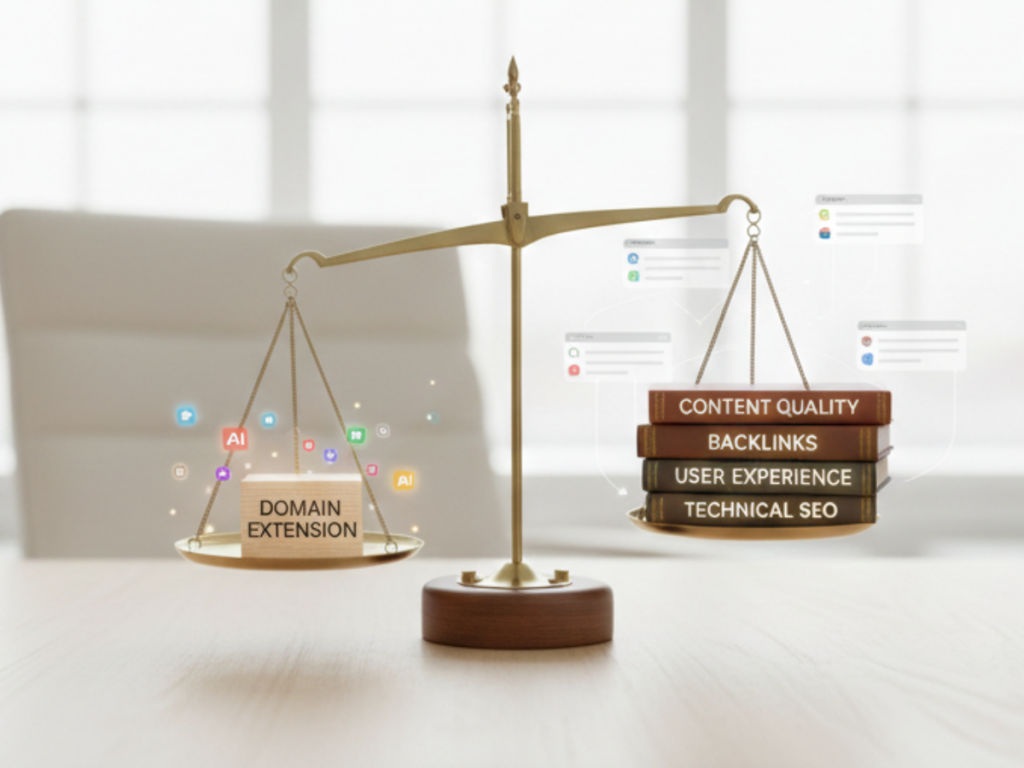
This is the official stance, and it’s important to understand: choosing .io over .com won’t hurt your ability to rank for your target keywords. If your content is strong, your site loads quickly, and you have quality backlinks, your domain extension is irrelevant to your search position.
However, this doesn’t mean extensions are entirely unimportant for SEO success.
How Domain Extensions and SEO Interact Indirectly
Whilst extensions don’t directly affect rankings, they influence user behaviour—and that’s where SEO implications emerge.
User Trust and Click-Through Rates
When potential customers see your website in search results, they make split-second judgements about credibility. Research shows that 75% of users prefer clicking on .com results when given a choice. This preference is rooted in familiarity and decades of conditioning.
What does this mean? If your competitor has a .com and you have a .tech, users might choose them simply because the extension feels more “official,” even if your content is superior. This leads to lower click-through rates (CTR), which Google uses as a signal of relevance and, in turn, affects why companies still back .com for trust and conversions. Over time, consistently lower CTR can indirectly hurt your rankings.
Newer or unfamiliar extensions like .xyz or .click face an even bigger trust penalty, sometimes associated with lower-quality or spammy sites. However, industry-specific extensions like .design can improve CTR in niche markets if the extension matches user intent.
Country-Code TLDs and Local SEO
ccTLDs like .in, .uk, .de, and .jp work differently. Google automatically geo-targets these domains, treating them as serving a specific country or region.
For local businesses, this is powerful. A law firm in London using .co.uk will rank higher in UK-specific searches than a competitor using .com, all else being equal. Research shows that ccTLDs hold 56% of Google’s top three positions across international markets.
The downside? ccTLDs also limit your global reach. A .in domain signals that your primary market is India, making it harder to rank internationally.
The TLD Shift in 2026: Why Businesses Are Moving Beyond .com
Despite the trust advantage of .com, several compelling reasons are driving businesses towards alternative extensions:
Availability and Affordability
.com is saturated. With over 157 million registrations, finding your ideal brand name is nearly impossible without hyphenation or expensive acquisition, which is why a clear domain naming strategy for business success matters so much. New gTLDs solve this problem.
Startups using alternative TLDs secure their exact brand name 88% of the time, compared to struggling with .com. A fintech startup can claim “Future.finance” or a design agency can secure “Creative.studio”—names that would cost thousands on .com. Pricing is also better: many ngTLDs cost less to register and renew. Understanding accurate domain valuation strategies can help you decide whether the premium price of a .com acquisition is worth the investment for your business.
Brand Signaling and Differentiation
A .tech domain instantly communicates your industry. A .shop signals e-commerce. A .finance indicates fintech expertise. This semantic relevance helps users and search engines understand what you do immediately. Choosing the right domain extension for maximum brand impact and differentiation in your market is a critical strategic decision.
Rapid Market Entry
Successful startups like Notion demonstrate this strategy, and their journey is a classic example of how the right domain choice supports long‑term brand growth. Notion began as Notion.so, enabling speed and memorability early on. After gaining traction, the company acquired Notion.com. The alternative TLD didn’t hinder growth—it enabled speed.
nTLD usage amongst tech startups has grown 50% in five years, whilst traditional .com adoption declined 28% amongst the same cohort.
Global Shift Away from Legacy TLDs
New gTLDs increased registrations by 15.9% year-over-year in 2024, reaching 37.8 million domains. Meanwhile, .com and .net experienced slight declines, reflecting a market reset: users and search engines have learned that new extensions can be trusted, a trend that also shows up clearly in recent TLD performance and auction data.
Which TLD Should You Choose?
For Global Reach: .com remains the safest choice if available. It offers the highest user trust and CTR advantage.
For Local Markets: Use your country’s ccTLD (.in, .uk, .de). It improves local SEO and signals local expertise.
For Tech and Startups: .io, .ai, .app, and .tech are now industry-standard. They communicate innovation and improve brand recall.
For Niche Industries: .shop, .blog, .finance, .design let you own semantic relevance combined with strong content marketing.
Optimizing Your SEO Regardless of Extension
No matter which extension you choose, these fundamentals matter most:
- Prioritise content quality — your domain extension is irrelevant if content is weak.
- Build quality backlinks — authority signals outweigh any extension disadvantage.
- Optimise Core Web Vitals — page speed and mobile-friendliness matter more than TLD.
- Implement proper geo-targeting using Google Search Console if using gTLD for local business.
- Craft compelling title tags and meta descriptions to improve CTR.
The Bottom Line
In 2026, the TLD landscape is more open than ever. Google’s equal treatment of all gTLDs means choosing .tech over .com won’t hurt your rankings. Your content, backlinks, user experience, and technical SEO are what move the needle.
However, indirect effects—user trust, CTR, and brand perception—remain real. The key is matching your extension to your business model and audience.
For established brands, .com still offers advantages. For startups and niche businesses, alternatives are now credible, affordable, and often smarter choices. The future isn’t about fighting for .com. It’s about choosing the extension that communicates your identity and supports your growth.
In practice, domain extensions and SEO only work in your favour when combined with strong content, links, and user experience.